It is through the tactile sense, beginning with touch between parent and child, that we first learn about our bodies and the surrounding world. As manual therapists, we help people through touch, and for the most part, all forms of caring touch are good. However, a new study shows some types of touch may be more powerful than others.1
This recent research, published in the Proceedings of the National Academy of Sciences, suggests that because the brain attempts to predict the sensory consequences of every action, it attaches less importance to self-touch, as this stimuli is predictable. The brain pays more attention to touch by others, or novel stimuli, because it is unable to predict the outcome.
Taking these findings a step further, we could say that novel touch during a therapy session, with the client actively engaged, should enhance sensory input even more—leading to increased nervous system stimulation and greater therapeutic impact. So, how do we put this insight into practice?
In Myoskeletal Alignment Techniques (MAT), we use "enhancers" to actively engage our clients and amplify the power of novel touch. A MAT enhancer is a therapist-directed movement cue that neurologically boosts, intensifies, and heightens a therapeutic outcome. MAT enhancers serve three primary purposes:
Retrain the brain using graded exposure stretching techniques.
Relieve protective muscle guarding and nerve compression syndromes.
Reward the client through proprioception and body awareness.
Case Study
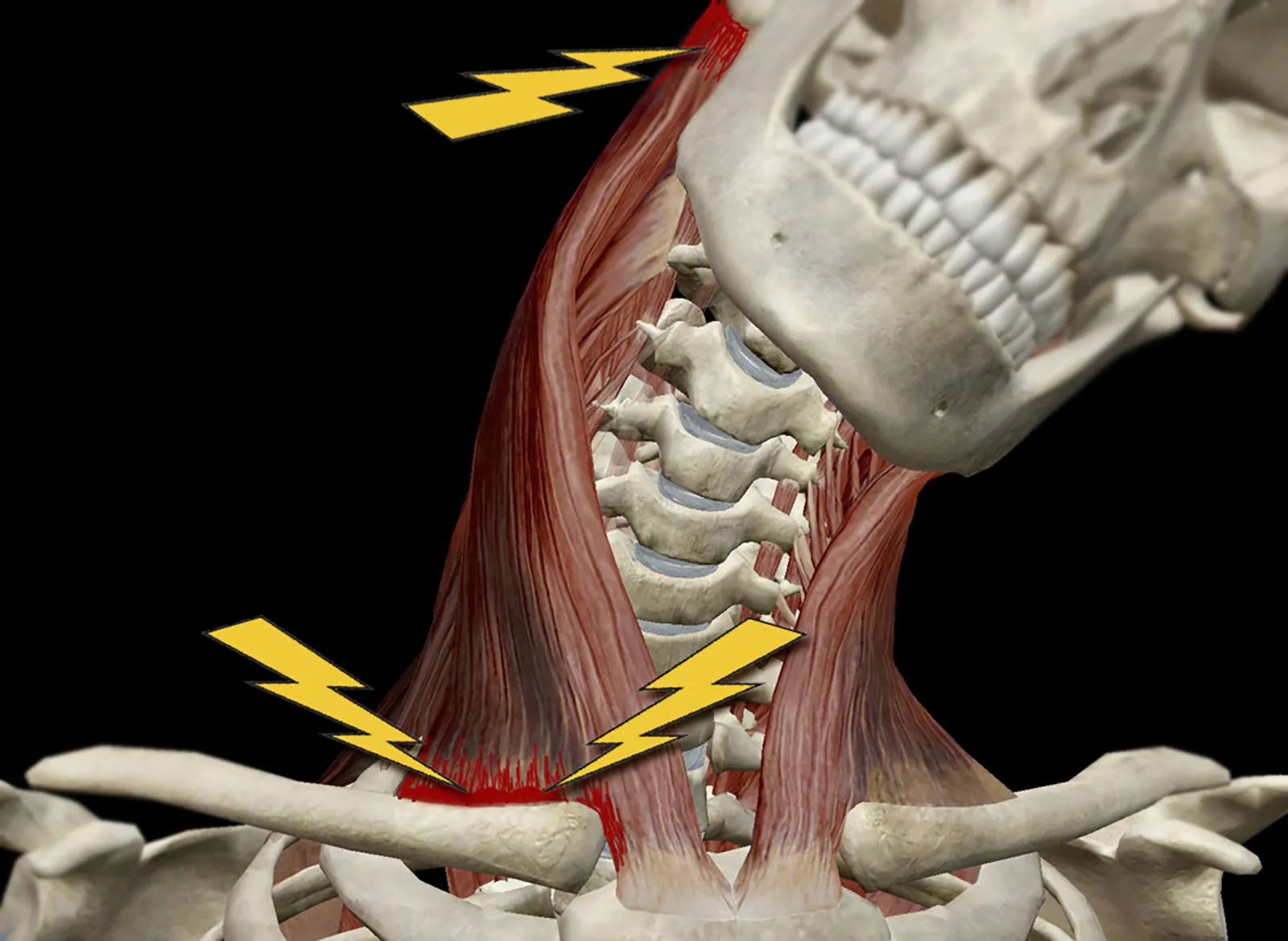
Image 1. A side-to-side whiplash injury strain to muscles, nerves, and joints.
Luke was referred by his personal trainer for neck mobility issues resulting from a direct blow to his left shoulder during football practice six months earlier (Image 1). Although most of his neck pain had subsided, Luke still struggled to left rotate his head enough to look in his rearview mirror while driving. Upon seated examination, his passive range of motion into right cervical rotation, flexion, and extension was normal. However, he could only manage 30 degrees of left cervical rotation and sidebending.
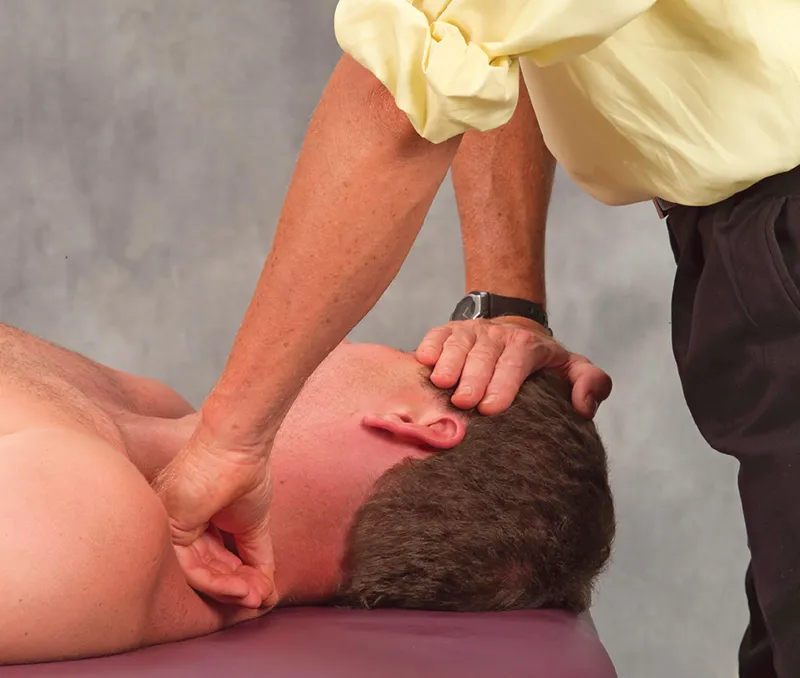
In Image 2, I demonstrate the first step in a myoskeletal routine to help address Luke's football injury. Notice how I begin with my right hand slowly left rotating Luke's head to the first (nonpainful) restrictive barrier as my soft left fist resists the effort. This creates a mild counterforce between the two hands. Luke is then asked to inhale deeply while gently right rotating his head against my resistance to a count of five and relax. With my left fist still pinning the hypertonic upper traps, scalenes, and splenius cervicis muscles, Luke is asked to look over his left shoulder (eye enhancer) while actively left rotating his head against my fist's resistance.
Image 2. To address the client's left rotation restriction, my right hand slowly left rotates his head to the first restrictive barrier as my soft left fist resists. The client takes a deep breath and gently right rotates against resistance to a count of five, then relaxes. The client is asked to look over his left shoulder while actively left rotating his head against my fist's resistance. Repeat 3-5 times and retest.
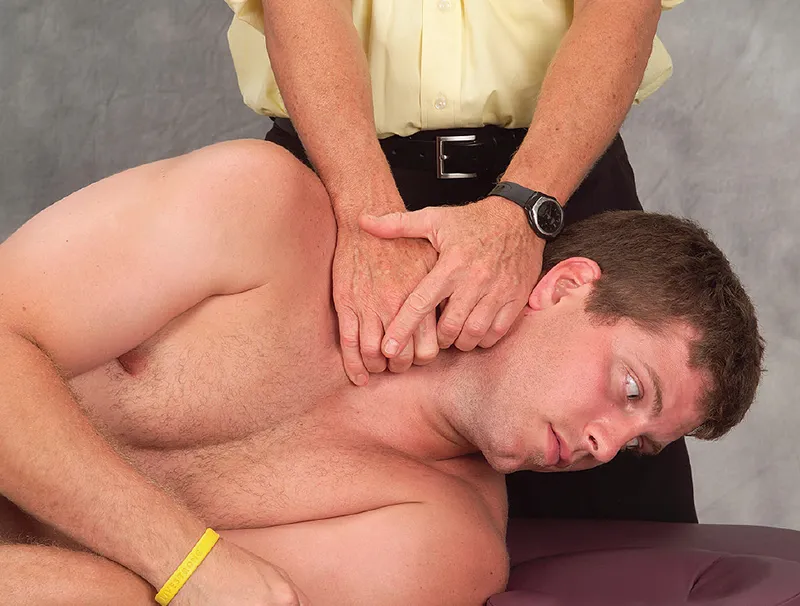
The above technique was repeated three times, then we retested for improved left cervical rotation. The MAT maneuver did help Luke regain some of his lost range of motion, but when I removed my hands and observed him actively left rotating, I noted visible reactive muscle guarding in his right sternocleidomastoid muscle (SCM). To address his SCM spasm using movement enhancers, I asked Luke to assume a left sidelying position, and I performed the graded exposure stretch described in Image 3. Afterward, Luke sat on the therapy table and repeated the head rotation test so we could see how freely his neck moved when gravitationally loaded. Although he felt less stiffness and greater overall flexibility, there was still something preventing full rotation.
Image 3. In this graded exposure stretch, the client inhales and lifts and slowly rotates his head to the first restrictive barrier to allow my soft finger pads to grip his right SCM muscle. Upon exhalation, he drops the right shoulder and slowly looks toward the table to a count of five, then relaxes.
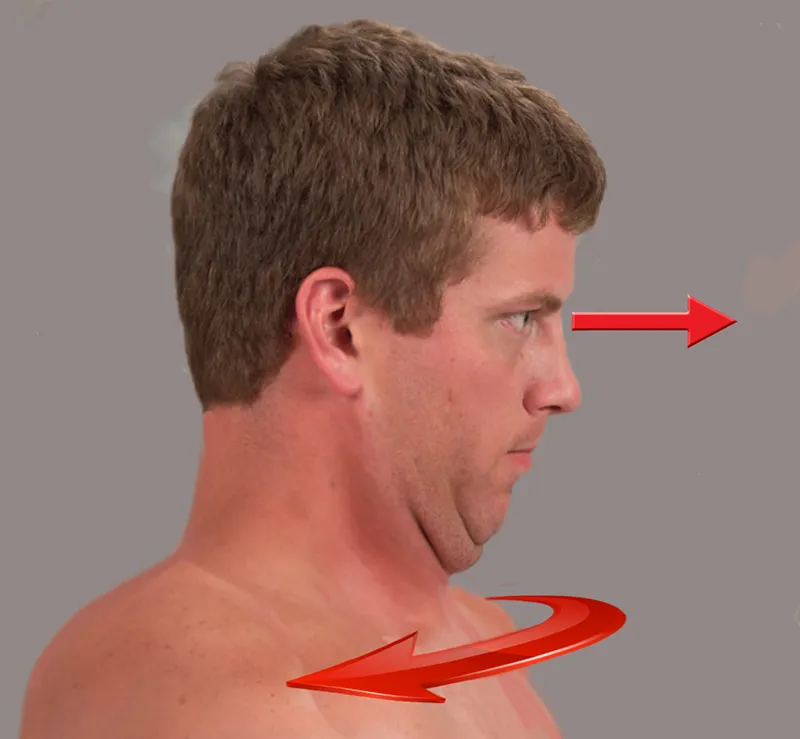
To determine if the brain was protectively guarding or if there was an additional musculoligamentous or nerve compression problem, I decided to try tricking Luke's brain with a different neck rotation approach. In a seated position with his chin tucked, Luke was instructed to focus his gaze on an object directly in front of him and slowly begin left and right rotating his shoulders (Image 4). As Luke's shoulders reached the end range of right rotation, I asked him to stop and observe what his head and neck were doing. He was astonished when he realized how far left his head turned simply by right rotating his shoulders. I suggested he practice this brain-based self-care exercise at home while observing himself in the mirror.
Image 4. Brain-based self-care exercise for cervical rotation restriction.
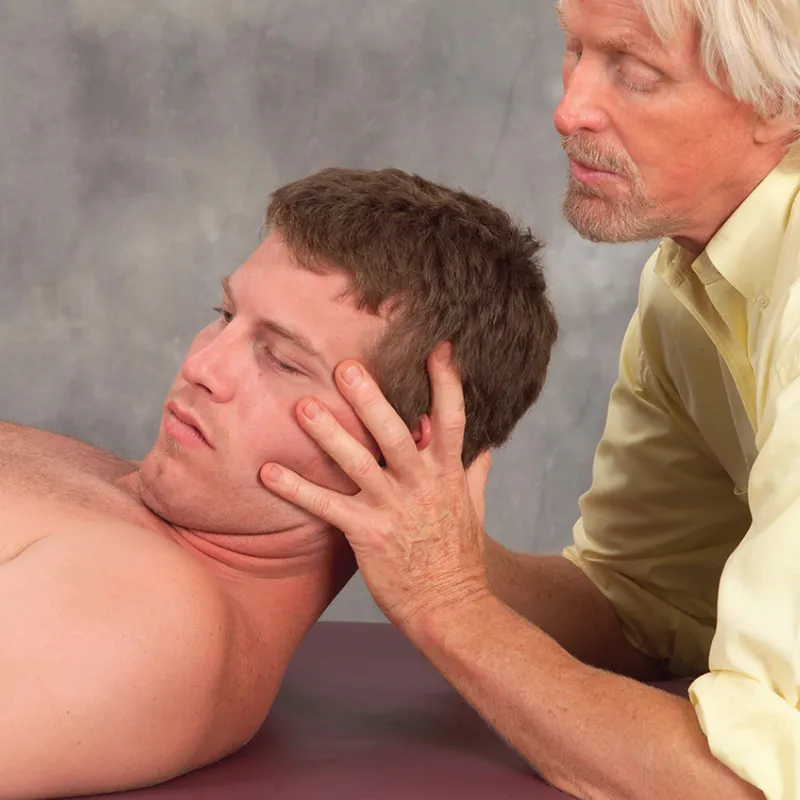
Now that I knew Luke's neck was able to fully rotate but the brain still had something locked down in spasm, I began palpating up and down his cervical spine, searching for protective guarding. As my fingers and thumb reached the base of his occiput, I noticed considerable right-sided suboccipital tone, particularly in his right inferior oblique muscle. As shown in Image 5, I used an optic-nerve (eye) enhancer to help relieve the suboccipital spasm that was preventing optimal atlas on axis joint rotation.
Image 5. With the client's head and neck flexed 90 degrees, I left rotate his head to barrier. Using the optic nerve as an enhancer, the client's eyes look right, and I resist the accompanying right head rotation. The client then looks left, and I follow this movement to relieve protective suboccipital guarding and increase range of motion at the atlas-axis joint. Repeat 3-5 times, then retest.
Throughout Luke's three-week treatment, I experimented with many myoskeletal techniques and enhancers, but those described in this article proved to be the most effective. Luke's commitment to his MAT enhancer homework was a big plus in his recovery, reducing his time with me and getting him back on the football field as quickly as possible.
Note
1. Rebecca Boehme et al., "Distinction of Self-Produced Touch and Social Touch at Cortical and Spinal Cord Levels," PNAS 116, no. 6 (February 2019): 2,290-99, https://doi.org/10.1073/pnas.1816278116.
To understand tissue-tension barriers, MTs must be constantly present and mindful. Too light and we will not become efficient at creating the healing change that is needed.