In the 1970s, San Francisco was at the center of a modern Fertile Crescent for massage therapy that spanned from the Esalen Institute in the south to beyond Marin County in the north. Esalen’s influence smoothed the rough edges of Swedish massage, and Marin added a soft touch while theories of body mechanics took shape that could be sustainable for a professional performing several massages a day.
Stocksy.
Tai chi was emerging as a popular meditative movement, and it seemed an ideal model for massage body mechanics. Take the bend out of the back and put it in the hips and knees. Thus, “the horse” and “the archer” were born. A problem with this model is that, while Asian meditative movements are recreational for an hour at the park, massage therapists can be active for seven hours a day. Using the tai chi model, the body is locked in a wide, low stance without access to free movement or body weight.
Finding the Stance
Three tools exist to create pressure in massage: strength, movement, and weight. The Dance Stance is a system of body mechanics that minimizes the use of strength and harnesses movement to access weight that can be directed into the therapist’s hands. This creates a massage that is flowy yet deep. This stance can reduce stress on joints and energize the massage therapist. With a high center of gravity rather than a low, wide stance, pressure is applied with ease.
Practice Before You Practice
For those who where taught massage in a low stance, it may take a while to learn.
Practice on a colleague or fellow learner for feedback.
Before beginning each stroke, position your feet in the direction of the next move.
Place a mirror in the massage room. Check your stance and posture periodically.
In the stance, our feet will typically be shoulder-width apart, with minimal flexion at the knees, hips, and elbows. The stance is the same posture we use for vacuuming or washing dishes. With the Dance Stance, we use our bodies in a way that’s familiar.
The system as taught by Margaret Elke at the Massage Institute of California in San Francisco was influenced by the work of Judith Aston. I was taught these mechanics as part of my basic training. Aston, who developed Aston Patterning, had worked with the instructors to maximize efficiency in the application of pressure while minimizing strain on the body. Over the 50 years I have massaged and taught, I have refined and defined the concepts of the Dance Stance so it could be better understood. While massaging full time, I have avoided injuries by letting my movement and weight do the work.
Practicing the Dance Stance
Before exploring the mechanics of the Dance Stance, note your table height: When standing at the side of the table with elbows extended, your knuckles should just touch the tabletop.
Application of Pressure
In this stance, pressure can be applied in three directions: diagonally, vertically, and horizontally.
Diagonal pressureis applied with the therapist’s body directly behind their hands. This is used for gliding strokes on all parts of the body. It is the most common direction for pressure application.
Downward vertical pressureis applied into the body for deep work or broad pressure. The therapist’s body weight is directly over the area being worked.
Horizontal pressureis applied in the same plane as the tabletop. This is typically done on the sides of the body (e.g., the iliotibial band or the superior shoulder), and the therapist may need to widen the stance slightly (or sit on a stool) and get low.
Positioning of the Feet
Align your feet in the following positions:
The feet should be aimed in the direction of the stroke. For example, to do a long stroke up the leg, the therapist’s feet are both aimed at the destination—the hip.
The outside foot (the foot farther from the table) is in the lead.
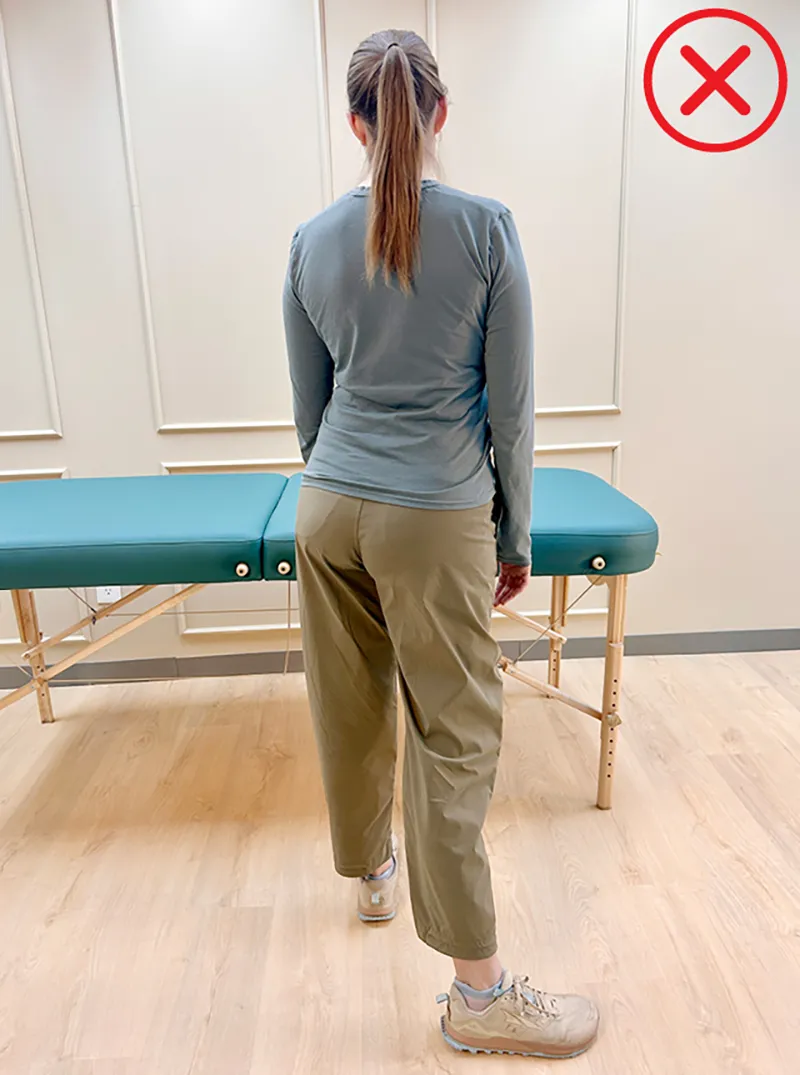
The back foot is not turned out (as in the “T stance” or “archer”). Image 1 illustrates the effects of back-foot turnout, which leads to the spine twisting at the waist (not what you want in your body mechanics). When both feet aim in the same direction, the spine is straight.
Image 1.
The therapist’s feet should be shoulder-width apart.
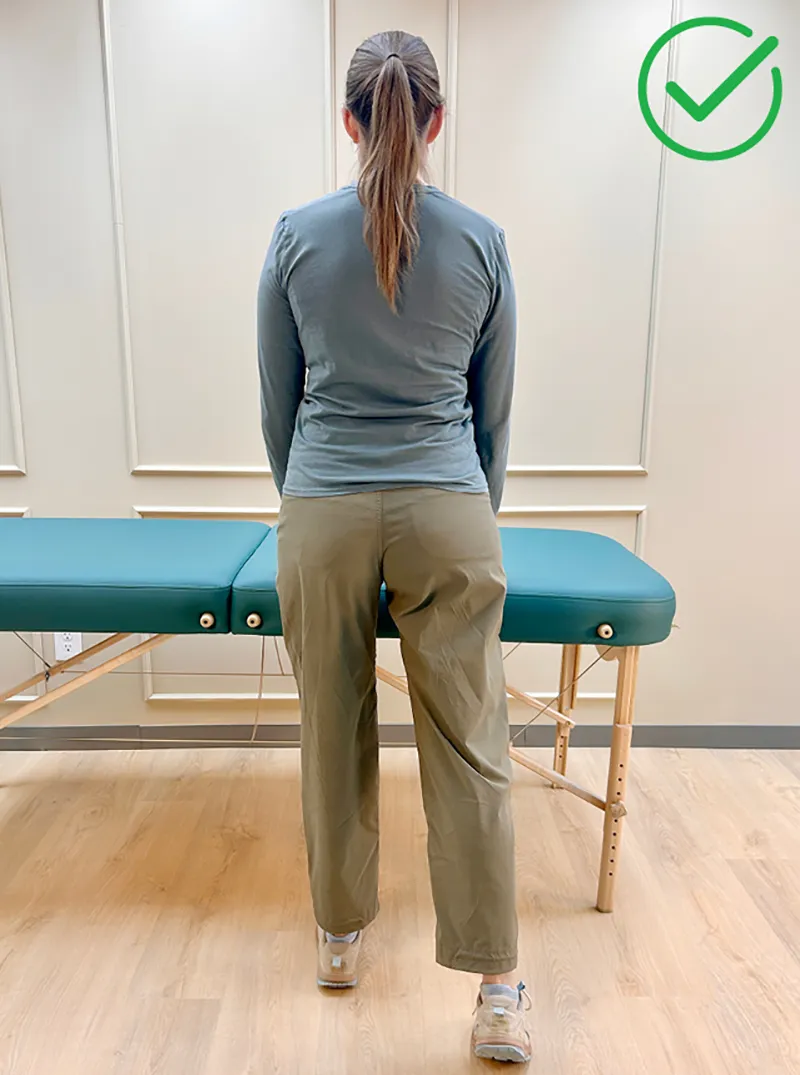
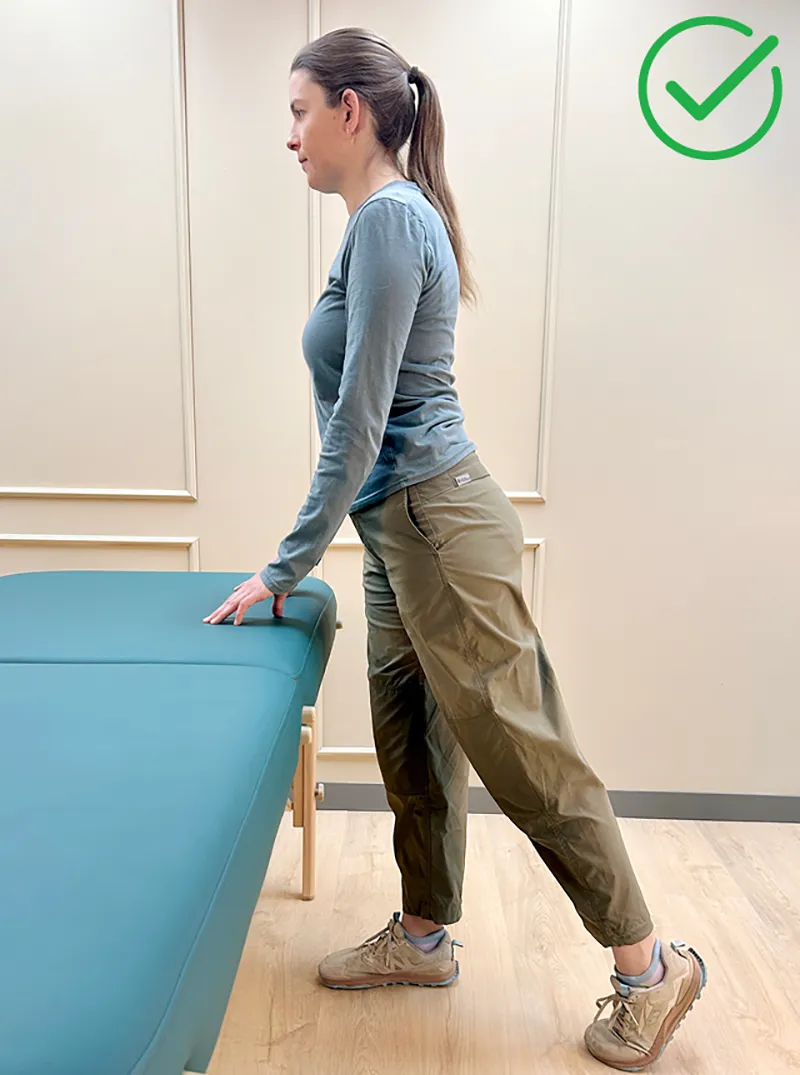
When the feet are properly aligned, as shown in Image 2, the hips and shoulders are squared.
Image 2.
Important to note: The heel of the back foot elevates to rock the body forward and tip the weight into the hands. The forward foot is weight-bearing. The front heel should not be lifted, or the leg will tire.
Extension of Joints
Access to body weight in the hands is gained through the extension of some major joints, as shown in Image 3.
Image 3. Massage & Bodywork.
There is plantar flexion (true extension) of the posteriorly placed foot.
The hip of the posteriorly placed leg is extended.
The hip of the anterior leg is straight.
The spine is kept straight with the pelvis tilted forward.
The chest and head are lifted.
The elbows are extended.
With a straight spine and extended elbows, hips, and knees, stress on the body is minimized while creating ease of movement not possible with a wide, low stance.
Positioning of the Arms
Your arms should be positioned in the following manner:
Keep them close to the body with the shoulders stable.
The elbows are extended—when they are bent, the spine is curved.
When the back heel elevates, the body moves as a unit to direct weight into the hands.
When the joints are extended, the body should form a diagonal line when viewed from the side.
Applying Diagonal Pressure
When ready to apply diagonal pressure to your client, the position of the feet, extension of joints, and positioning of the arms are all important to your body mechanics. This would include long strokes such as effleurage up the leg.
Aim both feet in the direction your hands are moving. For a long stroke up the leg, both feet are aimed at the hip.
The back (interior) heel elevates, creating the movement forward.
Applying Downward Vertical Pressure
When applying downward vertical pressure, align yourself as follows.
The body is centered as much as possible over the area being massaged.
The shoulder is over the tool (thumb, hand, fist, or elbow) being used.
The feet are shoulder-width apart.
The inside heel is elevated to increase weight being directed into the tool.
Applying Horizontal Pressure
When applying horizontal pressure, know:
Your stance may widen slightly more than shoulder-width.
Your knees and/or elbows may bend.
Other Movements
For movements that don’t apply to previous positions, keep in mind:
For strokes done facing the table (such as kneading), position your feet shoulder-width apart with knees slightly bent. Weight may shift from one foot to the other. These are not pressure strokes, so they don’t need access to body weight.
Your thighs may touch the side of the table, but they should not be used to lean weight into the table. When this happens, the body locks into position and all movement comes from the waist, limiting access to weight and movement.
Find Your Groove
Massage music can be thought of as slow and flat and might not encourage movement. So change it up. With appropriate clients or friends, spice up your massage with rhythmic music that encourages movement. Smooth jazz and dynamic New Age tunes can help you be light on your feet.
If you have a full-length mirror in your massage room, check your posture regularly as you learn and evolve with the Dance Stance. Are your joints extended? Are you up over your work? Are you moving? Play that lively music and dance!
Is the Dance Stance Difficult?
Many students complain about new aches and pains as they learn massage (many veteran therapists complain about old aches and pains too). Students are taught to lock their bodies in a low position with their feet wide apart. Keeping the knees and hips flexed for long periods can stress the body because the psoas is contracted while weight-bearing, pulling at the lumbar vertebrae, and the quads are engaged for extended periods. With the lower body locked into position, movement and pressure come from the lower back, shoulders, arms, and hands.
Using the Dance Stance will help minimize discomfort while adding pressure and flowing movement to the dance of massage.
To understand tissue-tension barriers, MTs must be constantly present and mindful. Too light and we will not become efficient at creating the healing change that is needed.