Being off-balance is often a good thing. The thrill of playing with our relationship to gravity is at the heart of a long list of activities we do for enjoyment: skating, skiing, surfing, hiking, dancing, tai chi, pickleball. In all of these, we intentionally shift our relationship to the center of the earth—a controlled fall, a flirtation with the edge of balance—and the result can be an ecstatic, expansive state.
Getty Images.
Q&A with Art Riggs
A legend in the profession, Art Riggs was a recent a guest on the ABMP-sponsored The Thinking Practitioner podcast. Catch the highlights.
But being unsteady when we don’t want to be? That’s a different story. Our fight-or-flight mechanisms are designed to commandeer our awareness, mood, and physiology when there’s a danger of falling. For aging populations especially, balance challenges are a big deal: Fear of falling can lead to reduced activity, social isolation, muscle loss, depression, and—ironically—increased fall risk, creating a vicious cycle with serious consequences.
What Do We Mean by Balance Issues?
When clients describe “balance problems,” they may be experiencing quite different things. Those variations could be:
Dizziness or lightheadedness might stem from cardiovascular or autonomic causes, such as blood pressure changes.
Fear of falling, or an overabundance of caution, is itself a potent factor that changes how people move, adapt, and hold themselves.
Unsteadiness on one’s feet can reflect proprioceptive deficits, muscle weakness, or joint stiffness.
Vertigo—the sensation that the room is spinning—often has vestibular origins, typically involving the inner ear.
To understand how we can help, we need to know how balance works. Our sense of balance emerges from the brain’s integration of three main sensory systems: vestibular input from the inner ear, visual information from the eyes, and somatosensory or proprioceptive feedback from throughout the body—especially the feet, ankles, and spine. When any of these systems is compromised, or when the brain struggles to integrate their sometimes conflicting signals, balance suffers.
Common balance-related conditions can include: benign paroxysmal positional vertigo (BPPV), where tiny crystals in the inner ear become dislodged; orthostatic hypotension, a drop in blood pressure upon standing; medication effects—many common drugs, including those for blood pressure, erectile dysfunction, sleep, anxiety, and pain, can affect balance.
Age-related changes in proprioception, tissue responsiveness, vision, and vestibular function compound the picture.
Why It Matters for Hands-On Therapists
Understanding these mechanisms helps us work with our clients more sensitively and safely. We can inadvertently trigger dizziness or unsteadiness without realizing it—through head position changes in susceptible clients or simply by having someone sit up too quickly at the end of a session. The pacing we use, the positions we choose, and our awareness of a client’s state all become part of how we support their sense of stability rather than threaten it.
Settle, Adapt, Refine
For hands-on work with balance challenges, I find it helpful to think of our goals in three overlapping layers: (1) helping clients settle, (2) helping clients adapt, (3) helping clients refine.
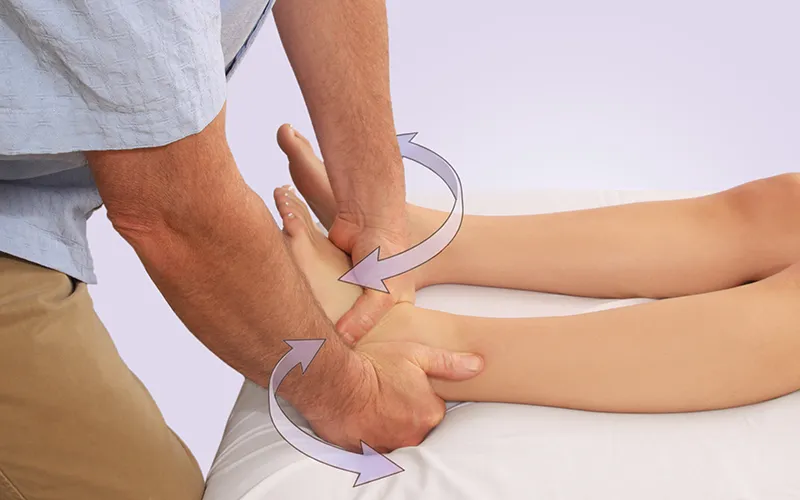
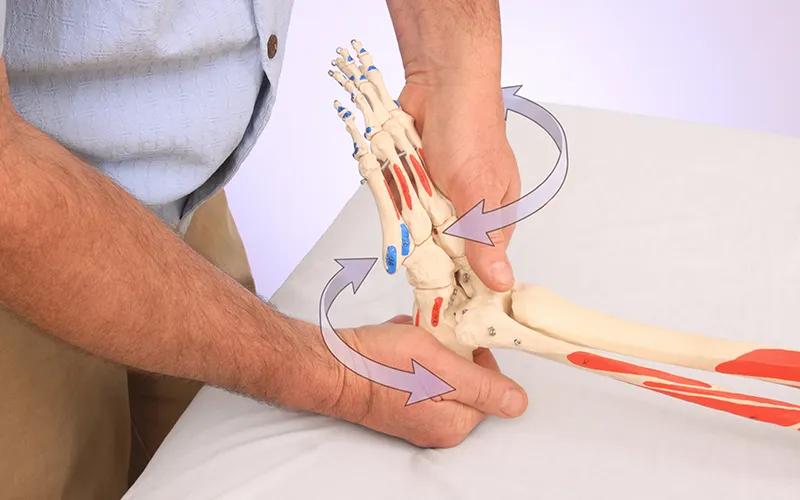
Arches: Wringing Technique
Arches: Wringing Technique. Gentle counter-rotation between heel and midfoot awakens the arches and helps enhance adaptive balance in standing or walking. Images courtesy Advanced-Trainings.com.
Indications
Balance difficulties
Foot pain or movement limitations
Purpose
Reduce unnecessary tone
Increase arch adaptability
Awaken and refine foot proprioception
Instructions
Hold the client’s heel in lateral hand, medial midfoot in medial hand. With gentle compression, slowly counter-rotate the foot between your hands to mobilize and awaken sensation of the medial and lateral arches.
Settling is a function of the autonomic nervous system. Massage and bodywork is particularly good at helping an agitated client find new levels of rest and calmness. When the nervous system perceives threat—and the prospect of falling certainly qualifies—it shifts into a protective, vigilant state. Hands-on work with someone dealing with vertigo or balance fears is an opportunity to help them downregulate, to rest into the experience of being safely supported.
Adapting means helping the body become more responsive and mobile rather than braced and rigid. When the world seems to be tipping, the natural response is to stiffen—to grip with the feet, brace through the knees and hips, hold the breath, and clamp down through the neck. This protective bracing, especially after a fall or a scare, can become its own problem: Reduced adaptability leads to a more fragile sense of balance, which leads to more bracing. Helping restore mobility throughout the client’s body—feet, ankles, knees, hips, spine, rib cage, neck—can help break this cycle.
Refining means enhancing proprioception, the body’s sense of its own position and movement. Proprioception is the foundation of coordination and motor control, and it responds beautifully to skilled touch. By bringing attention to specific body regions and their movement possibilities, we help the brain’s sensory and motor maps become more detailed and accurate.
The good news is that a single well-crafted technique can accomplish all three goals at once.
Key Territories
The following regions of the body are significant when it comes to balance:
The feet are the literal foundation of standing balance. Reducing unnecessary tone, differentiating the myofascial structures, and awakening the proprioceptors of the plantar surface all allow for more refined postural adjustments. Helping clients sense and use their medial and lateral arches, restore dorsiflexion, and enhance plantar surface awareness can make a tangible difference in how steady clients feel (see “Arches: Wringing Technique”).
Knees and hips that can soften rather than brace provide the shock absorption and responsiveness that balance requires. Encouraging mobility here supports the whole system’s adaptability.
Breathing is the foundation of both responsiveness and support and key to autonomic calming. Clients who are bracing against instability often hold their breath or breathe shallowly. Helping restore full, relaxed breathing supports settling, and the rhythmic motion of respiration itself contributes to postural adaptability.
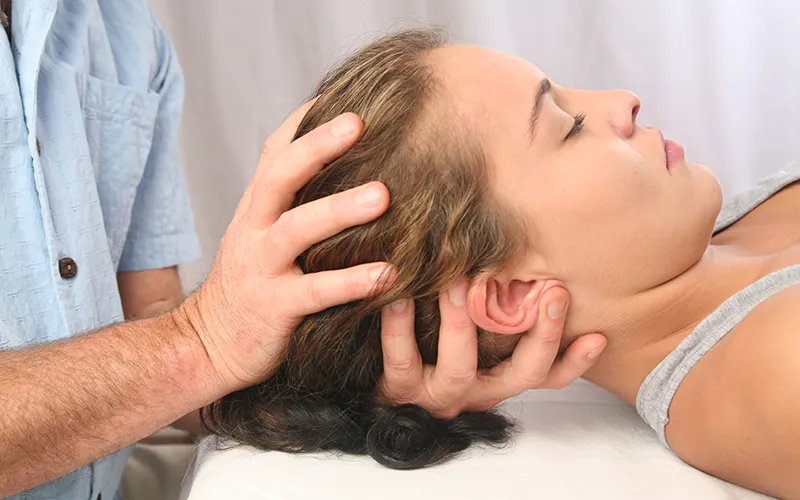
The neck and head deserve special attention, because two of our three main balance inputs—the vestibular organs of the inner ear and the eyes—are located in the head. The neck, which must remain mobile enough to orient the head freely while stable enough to support it, often bears the brunt of protective bracing. Restoring adaptability here can be a particularly powerful way to help someone dealing with balance challenges (see “Vestibular-Orienting Technique”).
Vestibular-Orienting Technique
Vestibular-Orienting Technique. Extremely slow, supported movement through neck flexion and extension helps lower the threat of head position changes, allowing greater vestibular adaptation. Image courtesy Advanced-Trainings.com.
Indications
Balance difficulties
Neck pain or movement limitations
Purpose
Reduce unnecessary bracing or guarding
Lower the threat to a variety of cervical positions and head angles
Instructions
With supportive contact, slowly flex the neck to its comfortable limit, then extremely slowly extend (lower) it.
Watch for dizziness, bracing, or guarding—pause well before aggravating any of these. Ask for easy breathing; proceed only when the client has released their head into your hands.
Opening eyes can help with dizziness.
Red Flags
Though uncommon, it’s good to be aware of situations that may warrant referral or postponement of hands-on work. Conditions like the following require medical evaluation:
Chest pain, shortness of breath, or palpitations
Fainting or presyncope
Fever with stiff neck
New double vision or vision loss
New hearing loss or severe ear symptoms
New weakness, numbness, facial droop, slurred speech, severe headache, or confusion
Recent head injury
Repeated unexplained falls
Sudden new dizziness or severe imbalance
Symptoms that are rapidly worsening
Cautions and Considerations
Here are a few ways we can support clients with known balance challenges:
Avoid sustained end-range neck rotation or extension in those with cervical sensitivity or protectiveness
Consider the effects of medications or alcohol
Keep lighting stable
Monitor for orthostatic symptoms when the client sits up
Provide support during sit-to-stand transitions
Stop or ease off if nausea or vertigo is triggered
Use slow position changes
Document your observations and encourage medical follow-up for persistent symptoms.
In Summary
How we work with balance issues is often more important than where. If autonomic activation is the issue, we can slow down and prioritize settling. If stiffness is the issue, we gently encourage mobility. And keeping proprioceptive refinement as one of our main goals leverages the unique power of our work to help people shift their protective reactions. Throughout, we balance playfulness with reassurance—calming presence alongside curiosity and a willingness to explore.
Balance, after all, is not a static achievement but an ongoing process of adaptation. Our work can help clients not only feel steadier but also develop a more confident, curious, and resilient relationship with that ever-shifting edge between exhilaration and alarm.
To understand tissue-tension barriers, MTs must be constantly present and mindful. Too light and we will not become efficient at creating the healing change that is needed.